




Cyber-physical Security for Airports & Airlines

Achieve operational resilience, meet compliance requirements and reduce cyber-physical risk with real-time context, OT/IoT-specific security controls and measurable resilience across all operational systems.

Heading 1

Subtitle 1

Heading 2

Subtitle 2

Heading 3

Subtitle 3


Heading 1

Subtitle 1

Heading 2

Subtitle 2

Heading 3

Subtitle 3

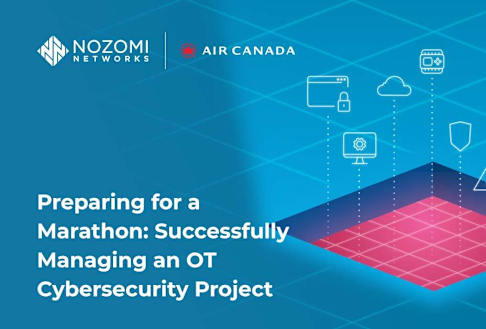
How to Build an OT Security Program in Aviation with Air Canada

Sandeep Lota, Field CTO at Nozomi Networks, and Renny Kochubaby, Cybersecurity Specialist at Air Canada, on what it actually took to build an OT security program across more than 50 distributed airport sites. Why asset visibility is the starting line rather than the finish, how third-party dependencies shaped the rollout sequence, and the IT/OT coordination that made it scale.

The Connected Airport

From baggage handling and passenger screening to approach lighting and instrument landing systems, OT and IoT networks play a crucial role in ensuring the safety, efficiency, and reliability of airport operations. A single terminal may have thousands of connected OT and IoT devices – many, if not most, of them unmanaged.
Anchor: Air-Canada-Case-Study

The Connected Airport: How OT and IoT Networks Expose Airports to Cyber-physical Risk 

Airports are small cities run by overlapping operators, and the systems that keep them moving — baggage handling, access control, HVAC, cameras — were built for reliability, not security. Michael Dugent on convergence, fragmented ownership, targeted threats, the overlooked IoT layer, and what EASA Part-IS now demands.
Read the blog

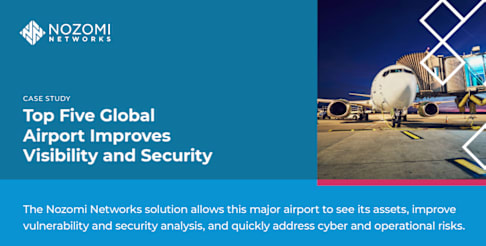
Top Five Global Airports Improve Visibility and Security

Read how this global airport gained visibility, improved vulnerability and security analysis, and can now quickly address cyber and operational risks.
Get the case study

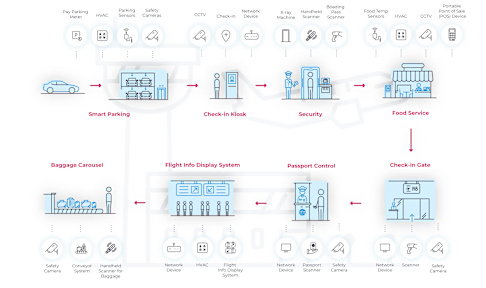
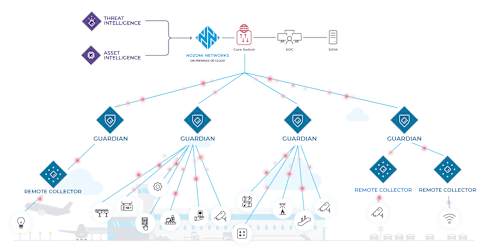
Sample Deployment Architecture for Airports

Nozomi Networks’ flexible, scalable architecture and integrations make it easy to tailor our solution for any airport environment.

Improving Airport Cybersecurity Starts with Visibility

How do you navigate all this change while maintaining continuity of service and improving cyber resiliency? Let’s look at security challenges faced by airports and how one top five global airport tackled them.
Read the blog
Anchor: How-Nozomi-Networs-Helps

Airport OT and IoT Systems That Must Be Secured

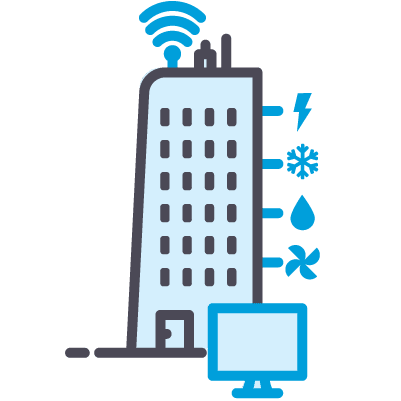
Terminal buildings & supporting infrastructure

Airport terminals have the same BMS challenges as other smart buildings – but on a much larger scale. Add to that power grids, water and wastewater systems, autonomous trains, traffic manageme...
Baggage handling systems that cannot fail

Mission-critical BHS sit at the intersection of operational continuity, passenger experience, safety and revenue. Few systems can cause instant, visible and cascading disruption as quickly as ...

Perimeter security & security checkpoints

Passport control, kiosks, baggage scanners, CCTV and other physical security devices and their communications must function flawlessly to ensure smooth security checks and passenger safety.

Display boards, sensors & other IoT devices

Ubiquitous IoT systems are connected to a variety of otherwise secure networks, often wirelessly, and often lack basic cybersecurity hygiene, making them easy to compromise.

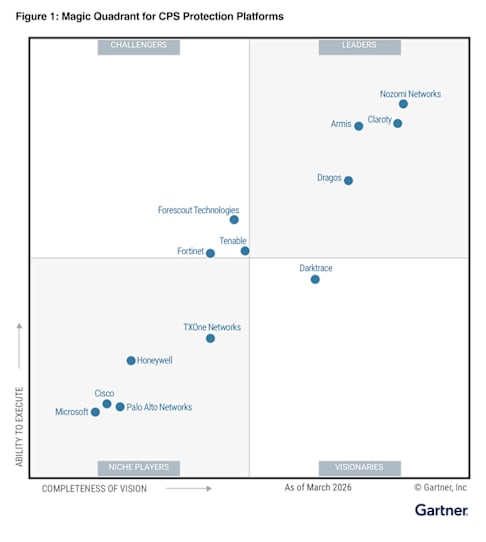
GARTNER® REPORT  A Leader. Again.

Get an Impartial View of the CPS Protection Platform Market From a Trusted Source. For a second consecutive year, Gartner has named Nozomi Networks a Leader in its Magic Quadrant™ for CPS Protection Platforms. Gartner evaluated Nozomi Networks alongside 12 other vendors and evaluated them on the basis of Completeness of Vision and Ability to Execute.  We couldn’t be more excited once again to be named a Leader by Gartner. We believe it demonstrates the results Nozomi Networks delivers for customers.
Get the Report
Anchor: Billc8-Resources

Explore Resources for Aviation Cybersecurity and Resilience

Access expert guidance, practical frameworks, and industry insights to help you secure aviation infrastructure, reduce cyber risk, and strengthen operational resilience.